

Lofoten - Beyond the Arctic Circle

How do you go about exploring a new area for photography? I've been oggling winter photos of Lofoten for a while now and last year I Googled photography tours up there, landing on Solgård Photos web page. Oslo-based Henrik and his co-leader Thomas are accomplished photographers and a lot of our interests overlapped - including wildlife - and so I signed up for a Lofoten photography workshop in March 2026. This ended up being the best introduction to the area that I could have wished for as we covered the whole chain from Å to Svolsvaer from our base in Leknes. Henrik in particular knows Lofoten as well as I know the Dolomites and did an excellent job of giving us a whistle-stop tour of the area.

I started out not really knowing where best to stay and not having a clear overview of the area. Now I have a good handle on what's where and how to get around. Could I have done this on my own with a good photography guide? Almost certainly, but this way I could hit the ground running and not worry too much about logistics. Next time (and yes, there will be a next time), I will feel more than confident to explore the area by myself and with greater flexibility than being confined to a group can afford.

The weather proved to be our biggest challenge. Although we started the week with snow on the ground, we saw a lot of rain and wind during the week and lost a lot of the covering that we had over the course of the week. Shooting with other photographers also keeps me from procrastination about going out, especially when the weather is inclement. Plus it would have been a lonely week up there all on my own and the guys were excellent company.
I was definitely not firing on all cylinders on my first afternoon at Uttakleiv. The combination of a new spot, a genre where I felt slightly out of my depth (coastal photography), being dependent on others for equipment (tripod) and the missing luggage weighing on my mind meant that I definitely wasn't bringing my A-game, despite the excitement that comes with visiting a new location for the first time. I still managed to get a couple of nice shots, though the Dragon Eye was too crowded for me to want to pay it much attention on this occasion. Fortunately a second visit later in the week proved much more profitable.

I ended up flying up a day early to ensure that I didn't miss anything on the first day. Whilst this meant that I had some dead time on the Sunday morning, I was able to join the guys for a trip to Haukland and Uttakleiv beaches in the afternoon and get the lay of the land. Had I flown up on the Sunday, I would have missed this session. Unfortunately, Widerøe airlines managed to re-route my main luggage from Tromsø to goodness-knows-where and it took a couple of days for them to locate it and get it back to Leknes. This put me off my game more than I care to admit and deprived me of a tripod for the first 2½ days.
Our waterfront cabin in Leknes gave us a view over the sea to the surrounding hills:
Views from the Cabin
Day Two
Day two took us down the E10 to The Wall and Bøosen before heading to the surfers' beach at Flakstad. The sun was just rising as we hit the road to Nusfjord, lighting up the peaks of the Barman Wall.
The Barman Wall
After a brief stop at The Wall, we drove round the corner to the stop below the Molneva waterfall, which at this point was still encased in snow and ice. The view across the Fjord gave us some nice reflections and a rare glimpse of sun. I was really happy with this find; a skein of ice left behind by the falling tide. Not quite as sharp as I'd like without a tripod, but I was happy with my photographic instincts. The cellphone photo was better for the foreground, but the sky ended up being blown out. Although the fjord is sea-water, the stream flowing into it must have reduced the salinity of the water enough for it to freeze at high tide, especially as fresh water stays at the surface.

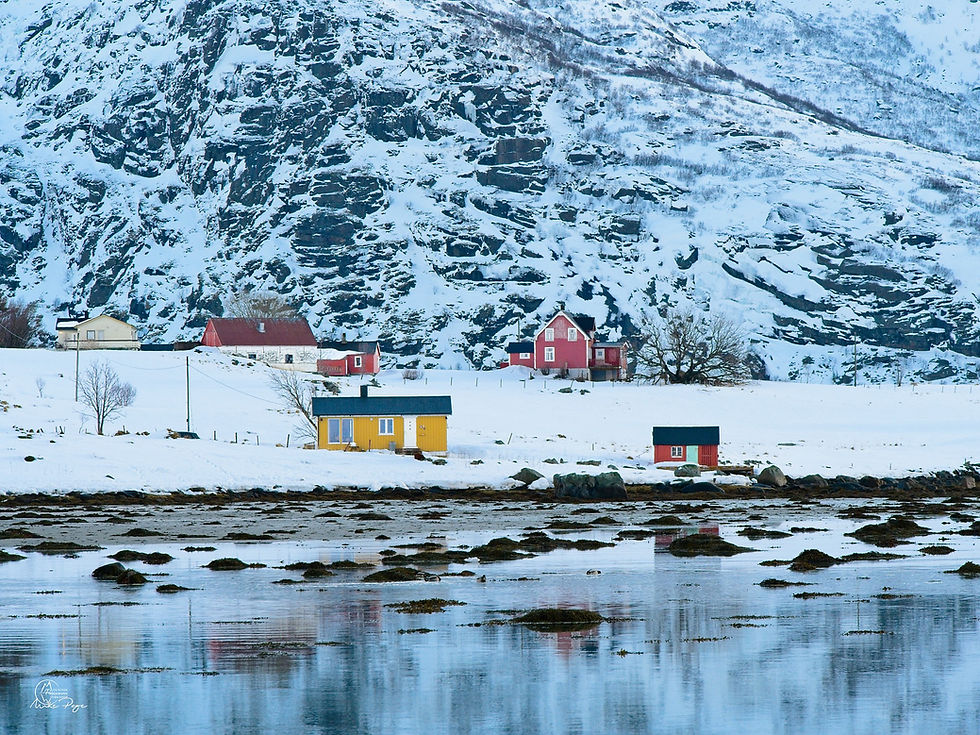


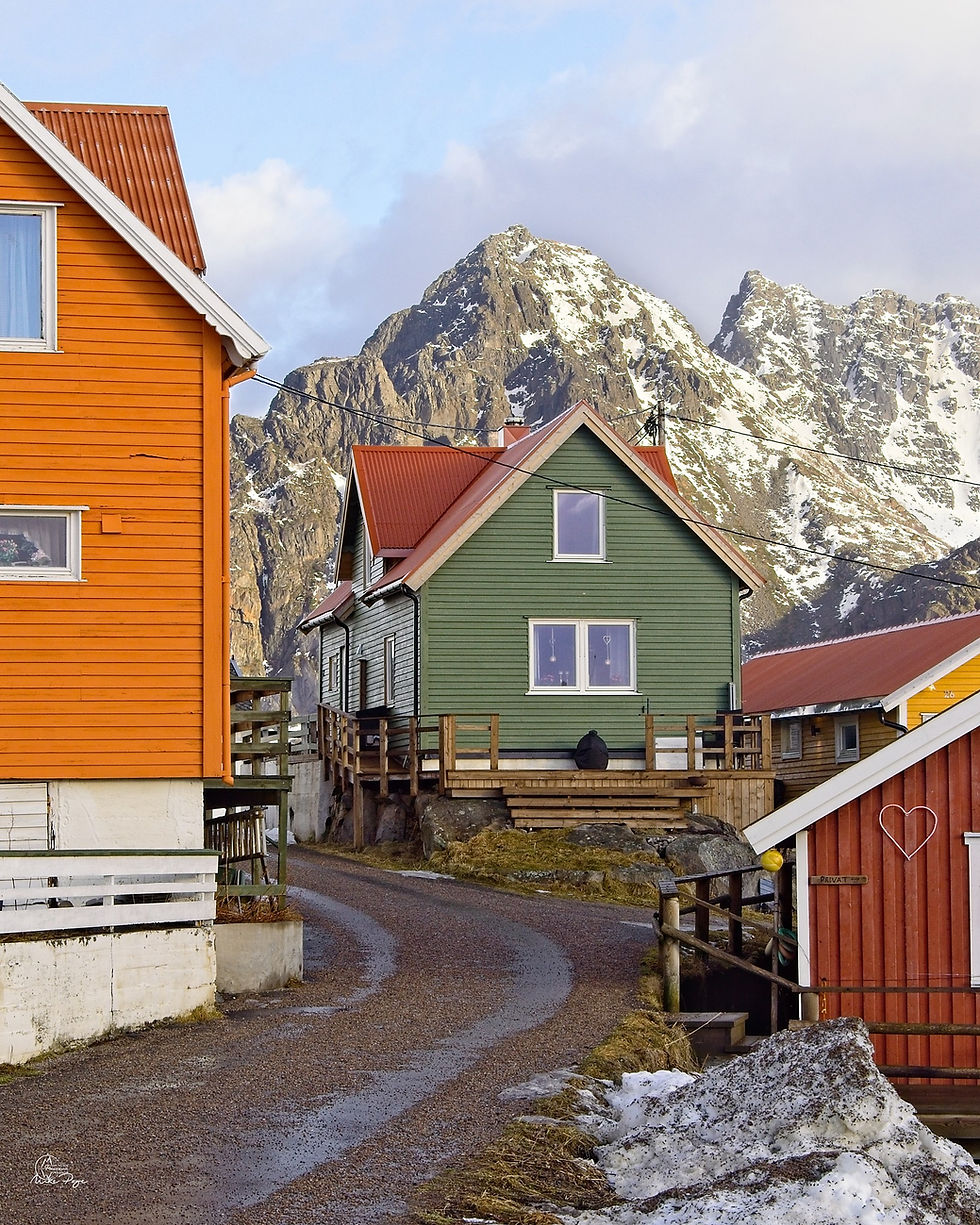
From Bøosen we drove to Flakstad and then back to Unstad where to my great surprise we found surfers in wetsuits in the arctic water. Apparently there are some beaches in Lofoten that are on the surfer circuit. The wind in Unstad was so strong that we couldn't stand still on the icy car-park. Despite the weather, at this point I just needed to get out, stretch my legs and explore with my camera. I really like the village shots below, the capture the real Lofoten off the beaten track rather than the fairytale-version that you get further down the peninsula/archipelago.


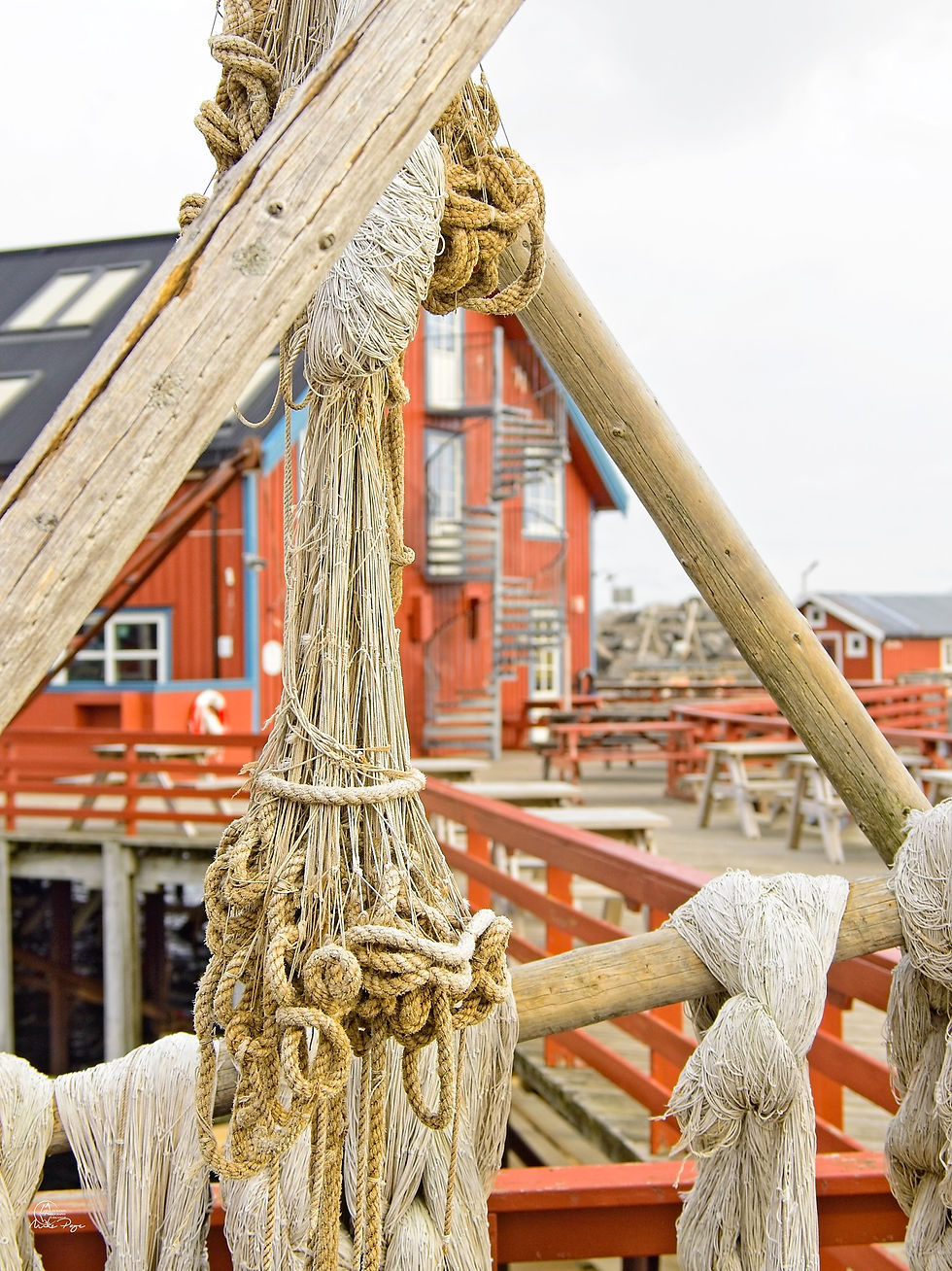
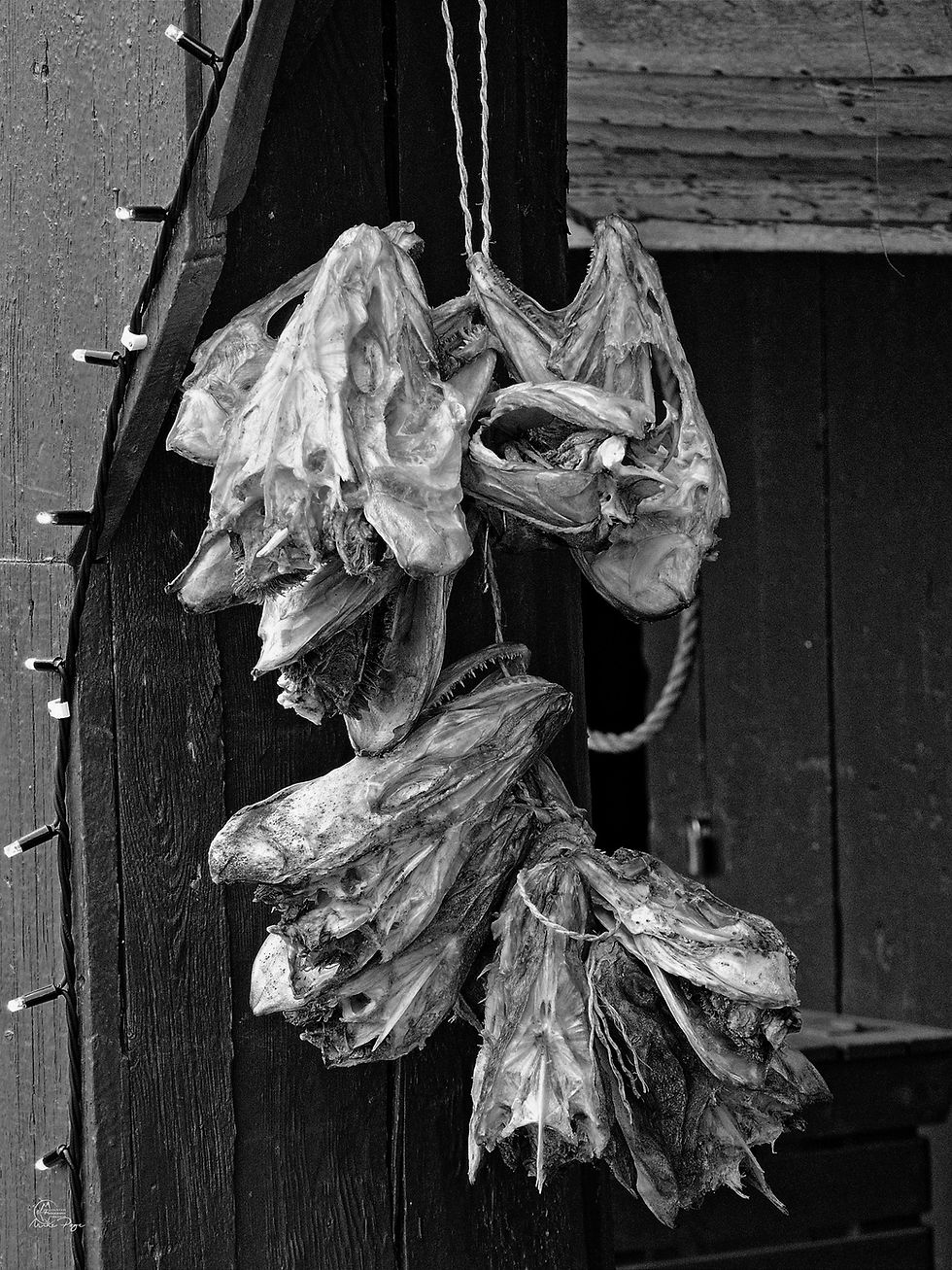
One of the things that you see everywhere in Lofoten are the fish drying racks. Sometimes it's just the heads, presumably ready to be reduced to stock, othertimes it's the whole fish. No salt, no preservative, just air-dried, whatever the weather. I actually tried the Stockfisk on the menu once in Leknes and found it incredibly chewy. I was assured by my dining companions that it shouldn't normally be like that, but in all honesty I fail to see the attraction over fresh cod. What it is, however, is an object lesson in the difference between being beautiful and being photogenic. Certainly not the former, definitely the latter!


Day Three
Day three saw us back on the road to the outer islands as we headed down to Reine and Hamnøy for a couple of the classic Lofoten views. Our first stop was at The Red Cabin in Ramberg. One of the unbelievable things about the islands is the colour of the water, a rich green/turquoise that seems out of place in this wintery environment. I guess my expectation for the colour of the winter sea is affected by scenes in the British Isles, where the water turns brown as the bottom silt gets stirred up. Here the sand enhances the natural colour of the water without adding particles to it, even when the surf is up.
Getting a good photograph of the cabin was more challenging than I care to admit: Straight on or oblique? From above the cabin or level so the roof intersects with the mountains? In the end I opted for this end-on view.

Moving on, we arrived at the bridge overlooking Hamnøy just in time to catch the last of the day's sun on the village - at 10:37 am. The rain came in then and so we popped into the incredible Anita's Cafe, where we had the most delicious fish soup.


Less than a minute later we lost the sun and ended up shooting Hamnøy in the shade. The cabins still stand out, but I do prefer the sun shot.


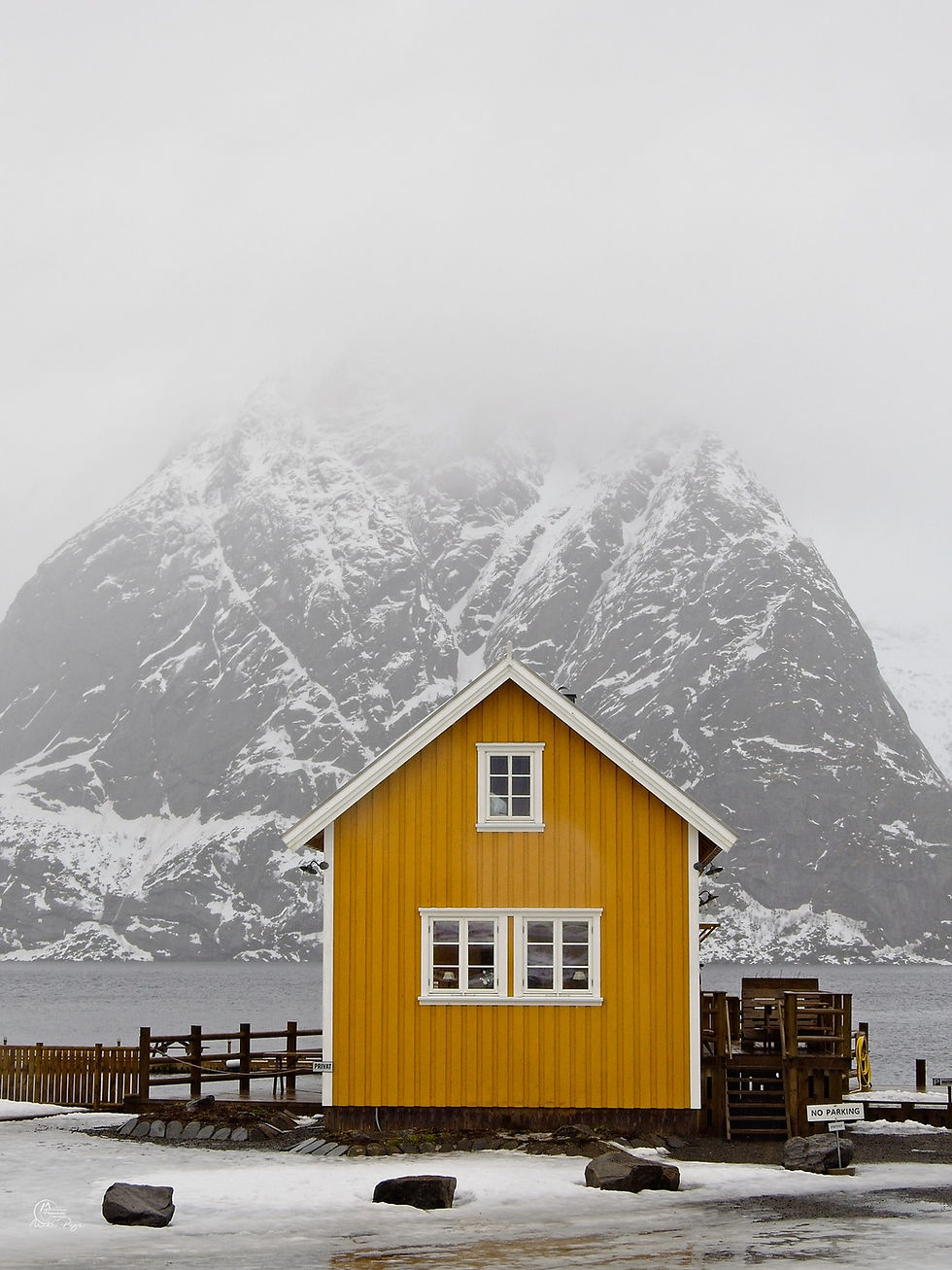


Whereas the islands at Reine more than lived up to expectations, the weather did not. One of the things that I have learned about my own photographic interests over the last year is that, unlike Ansel Adams, I love to incorporate man-made structures in my images, provided they fit the environment. Buildings like Gasthaus Aescher in Switzerland and the Chapel at Wankerfleck spring immediately to mind as examples. The Rorbu - the red fisher cabins typical of the Lofoten area - are a great example of this. The contrast of the red (or yellow) with the environment really stands out, but nevertheless the buildings fit in. They belong somehow.
I've spent quite a lot of time trying to analyse what the attraction is and I've come down to two things. Firstly, incorporating structures like this in the images anchors them in a country or region: These images can only be of northern Norway. Secondly, it gives me hope that we can exist in a natural ecosystem without destroying it or marring it, perhaps even whilst enhancing it. I live in hope.
Day Four
Day four saw us heading east for a change to the coastal town of Svolvaer for a special excursion. Henrik had booked us on a 2 h boat trip to photograph whit-tailed sea eagles. A bit of a risky undertaking in an open rib-boat with €4,000 worth of sensitive camera gear. The Olympus - sorry OMDS - weather sealing gave me some reassurance, but the sea is no friend to electronic gear.


After getting geared up with warm buoyancy suits and life-vests we were proceeding to the boats when disaster struck. We were walking down the metal ramp to the pontoon - a height difference of around a meter at this state of the tide. The ramp collapsed under our combined weight, dropping most of us onto the pontoon but pitching my fellow participant into the water, equipment and all. She ended up soaked which resulted in her abandoning the tour for the day. After establishing that she was going to be ok though, Henrik and I proceeded to join the tour.

I ended up taking both the 100-400mm and 12-100mm lenses with me on the tour. I wasn't sure whether I would need the shorter lens; I'm used to birds of prey being a long way off and didn't know how close we were going to get. Some of the best shots ended up being with the shorter lens on the way back from Trollfjord. I took around 1,500 shots of the eagles, a lot of them frame-filling like this. The bootmen throw frozen herring chunks into the water, encouraging the birds to dive for us tourists.
White-Tailed Sea Eagles in Lofoten
As we were leaving town after the tour, we spotted a rainbow out over the sea and were able to catch this panorama of Svolvaer church.

Day Five
We didn't just hit established spots while there but took some time to go off the beaten track. On the Thursday morning we headed down to Mortensund south of Leknes where we spent an hour or so exploring. This is much more my kind of photorgraphy than rocking up at an established spot and getting THE shot. Was I happy to get the classic shots of Hamn, Reine and the Dragon's Eye at Uttakleiv? Absolutely, but at the end of the day, I derive infinitely more satisfaction from coming up with my own compositions, even if they end up not being completely original.


Exploring Mortensund
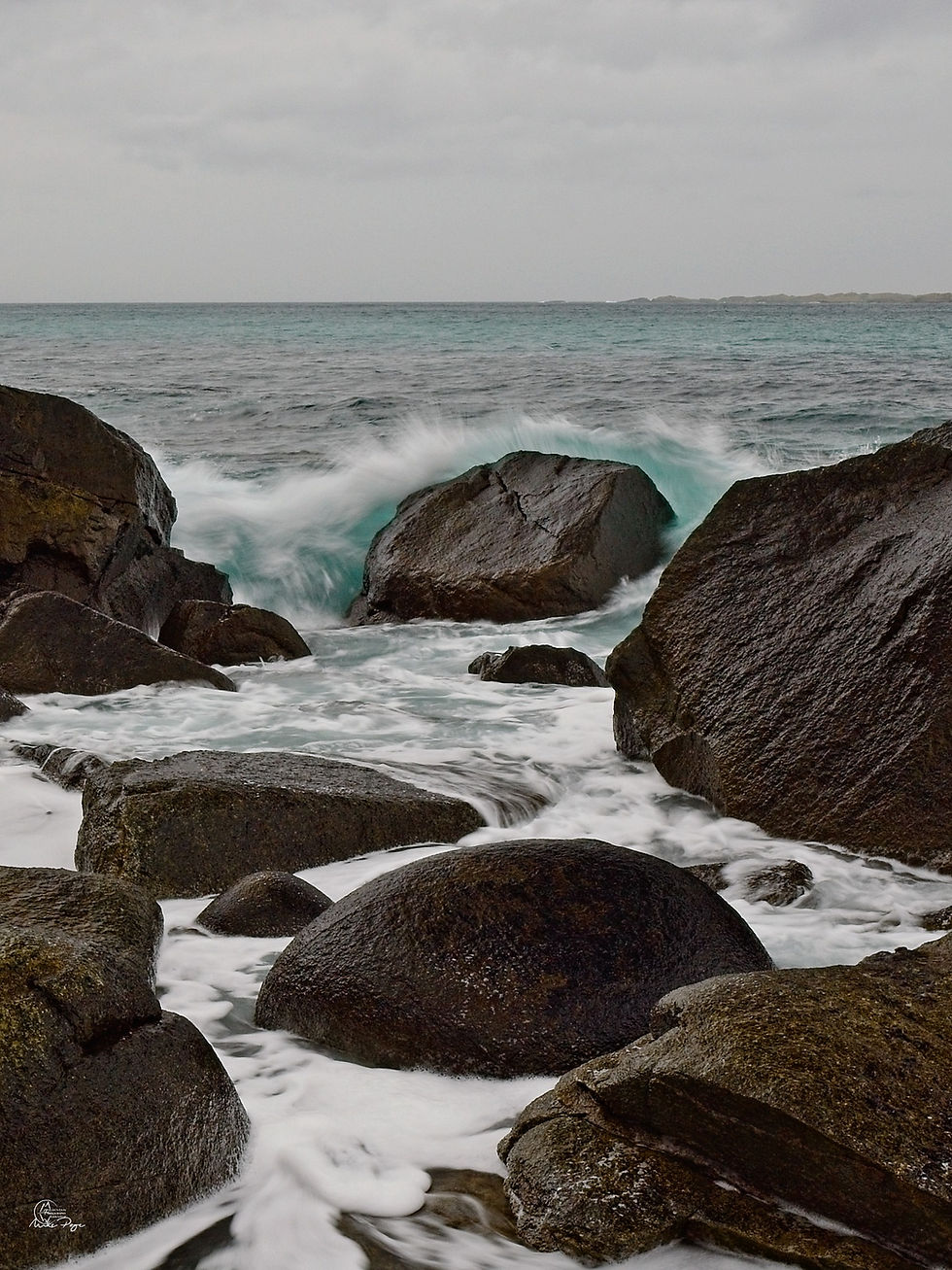
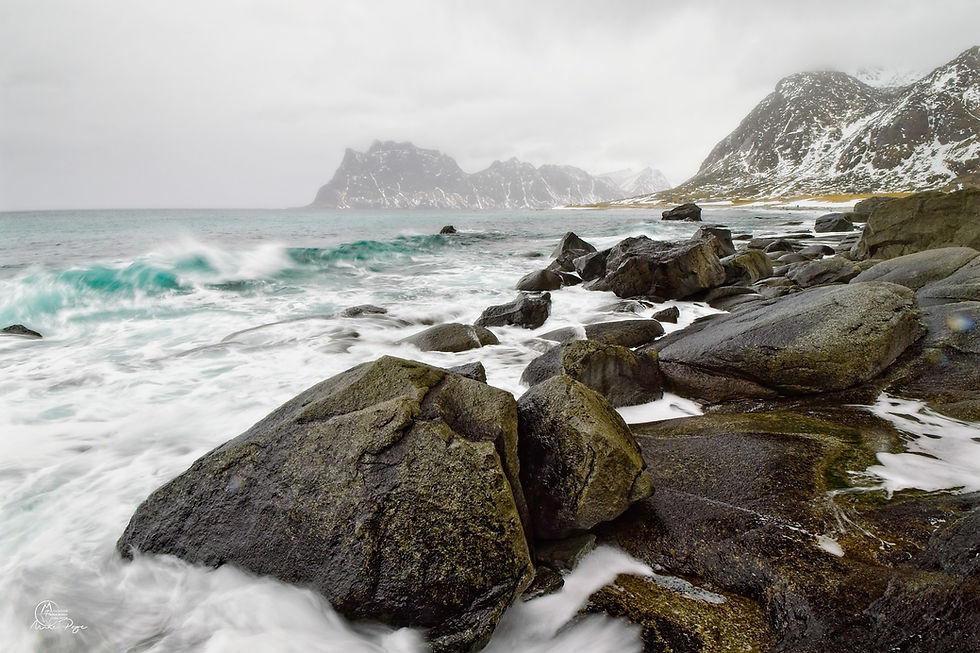
The afternoon saw us heading back to Uttakleiv to see whether we could capture the Dragon Eye again. We arrived just before high tide to a more-or-less empty beach and no Eye; it was below the sea at this stage. We went to the spot to see what was going on and were able to come up with a couple of compositions, but slowly people began to congregate making me uncomfortable and so I went in search of other shots. I've already mentioned the colour of the water here, but the images here really bring this out. The moody clouds over the Dragon work well at this spot.



Day Six
In the morning we headed east again, this time to Henningsvaer, home to one of the craziest football pitches in the world (Google it!). On the road we were hit by another rainbow across the water and had to stop and capture it.




There's a lookout point off the E10 just before Bøstad and the weather cleared just enough for us to catch these views of the Bøstad church.


After leaving the viewpoint we headed north to Eggum as the place had been recommended by some friends. The weather window had closed by this point and the wind had picked up. We weren't able to capture any of the big views at Eggum, but the surf gave us a few images.


We decided to stop at Haukland to capture the sunset on the way back. After a quick grab shot down on the beach, I headed to an outcrop above the sand. I'd wanted to take an image incorporating the S-curve of the stream running through the sand and really struggled to arrive at a composition that worked. As soon as I gave up on incorporating the mountains to the left of the gap out to the open sea (second image), it all came into place (third image). I think in retrospect I probably should have been closer to the edge of the rock, but it's a cool view over the new cafe and the tunnel to Uttakleiv.


Day Seven
On our last day we drove to the westernmost end of the E10, the village of Å. It was a day of many stops and mixed weather. The first stop was just before Morpheus Beach: The tide was out and the water was still enough to get some great reflections (see the very first image above). I was particularly happy with the wide-angle shot below incorporating the seaweed as structrural foreground. I've been fighting for a while to master this wide-angle technique; the shots need a strong foreground element (here the seaweed), a background that's strong enough to accomodate the shrinkage inherent in wide-angled photography and a mid-ground that connects the two. If you get it right, you can end up with a really compelling image. I think this one works!

The ice was now mostly gone from the Molneva waterfall and so that was stop number two. As Henrik and I worked our way up the waterfall trying different compositions we were aware of a familiar-looking figure in blue working the spot above us. As we got closer I realised that it was Stuart McGlennon, a British award-winning landscape photographer whom I follow on YouTube. We had a brief chat and after he'd finished this particular spot I wanted to try and see if I could make it work for myself. After much fiddling to position the camera just right, I managed to come up with this. Again, I'm really happy with the result.

As we drove further along the E10, there was another outlook affording us some views over the sound


The weather precluded stopping at Hamnøy and so we carried on down to the far end of the E10, the village of Å which, like Nusfjord, is more or less a living museum, at least down at the harbour.

Alongside the sea eagles, hooded crows are everywhere on the islands, in fact the crows can often be seen accompanying the eagles, waiting for scraps. Å is also home to a noisy colony of Kittiwakes, constantly squawking to their mates.


One final stop at The Wall in far more forboding conditions, a spontaneous stop in light of the conditions. A very different set of images from day two.


Tromsø
Although I was able to fly up from Munich to Leknes in one day, I ended up splitting the return journey over two days. After spending the night immediately after the workshop on a farm B&B between Leknes and Haukland, I spent a wet Monday morning hunting for compositions and coming up empty-handed.
A short plane-ride later we landed in snowy Tromsø thanks to Widerøe Air. My B&B for the night was the Fjord Explorer, a boat moored to the front of Tromsø town key. After a great last seafood meal in Fangst (10/10, would do it again), I strolled around town with my camera in the blue hour.


The next morning I spent a couple of hours walking around town, catching the Gateway to the Arctic as well as the Tromsø waterfront in the weak winter sun.


That just about wraps it up for my first trip north of the arctic circle. As you can imagine, I'm already planning my return visit in a couple of years. I think next time I'd stay further down the archipelago and take the hit on longer drives to Svolvaer and Vestvågøy. This would position us closer to the villages should the skies open up at night - something which didn't happen while we were there. Apparently, at this time of year you're almost guaranteed norther lights every night, provided the clouds clear. Watch this space.


Comments